SDK generator from OpenAPI
Migrate off Stainless Read moreGenerate idiomatic, type-safe SDKs and a CLI from the OpenAPI document your team already maintains. TypeScript, Python, Go, Java, Kotlin, Ruby, and CLI targets are generally available, and six more languages are available as experimental targets. Pick your targets, review real code in minutes, and publish from your own repositories through pull requests you control.
import WarpAPI from "warp-hr";

const client = new WarpAPI({
  apiKey: process.env["API_KEY"], // defaults to the API_KEY env var
});

const assignments = await client.timeOff.listAssignments();
import os

from warp import Warp

client = Warp(
    api_key=os.environ.get("WARP_API_KEY"),
)

time_off = client.time_off.list_assignments()
package main

import (
	"context"
	"os"

	sdk "github.com/TeamWarp/warp-go-sdk"
	"github.com/TeamWarp/warp-go-sdk/option"
)

func main() {
	client := sdk.NewClient(
		option.WithAPIKey(os.Getenv("WARP_API_KEY")),
	)

	timeOff, err := client.TimeOff.ListAssignments(context.Background(), sdk.TimeOffListAssignmentsParams{})
	if err != nil {
		panic(err)
	}
	_ = timeOff
}
Generate from the OpenAPI 3.0 or 3.1 document your team already maintains. Swagger 2.0 is upgraded on load.
Each target is written to the conventions of its language, not templated from one shared shape.
Edit generated files directly. Every rebuild carries your changes forward through a three-way merge.
API keys, Basic, Bearer, OAuth 2.0, and OIDC, wired from the security schemes in your description.
Versions, changelogs, and releases land as reviewable pull requests in your own repository.
Generate a full command-line client alongside your SDKs, with typed flags and structured output.
Server-sent events, newline-delimited JSON, WebSockets, and multipart file uploads.
Every SDK ships an Agent Skill and a generated reference, so agents call your API correctly.
Why teams generate SDKs with Scalar
- SDKs that already ship. Warp publishes its TypeScript, Python, and Go SDKs and its CLI from Scalar, after moving off a discontinued vendor with no breaking changes for its users. Read the Warp story. Profound and Dedalus Labs run Scalar-generated SDKs in production too; see customers.
- From the team behind a 15.7k-star open-source project. The same OpenAPI tooling powers the MIT-licensed Scalar API Reference, which Microsoft Learn documents for ASP.NET Core and eight frameworks ship as their default documentation UI.
- Honest about maturity. Seven targets are generally available and carry end-to-end tests. Everything else is labeled experimental, in the dashboard and on this page, until it earns the label.
An SDK generator reads your OpenAPI document and writes the client library your users would otherwise write by hand: typed models, one method per operation, authentication, retries, pagination, and a README. Scalar does that per language rather than from one shared template, so a Python client reads like Python and a Go client reads like Go. The language pages go deeper on TypeScript, Python, and Go.
Your OpenAPI document has to come from somewhere first. If it is generated from code, the framework guides for .NET, FastAPI, and NestJS show how to get a clean document out of your app, and generating an SDK from OpenAPI walks through the whole process. For the bigger picture, start at the learn hub.
Targets and registries
Every target publishes to the registry its ecosystem expects, using workflows generated into your repository.
Generally available
| Target | Package registry |
|---|---|
| TypeScript | npm |
| Python | PyPI |
| Go | Go modules |
| Java | Maven Central |
| Kotlin | Maven Central |
| Ruby | RubyGems |
| CLI | npm and Homebrew |
Experimental
| Target | Package registry |
|---|---|
| C# | NuGet |
| PHP | Packagist |
| Rust | crates.io |
| Swift | Swift Package Manager |
| Dart | pub.dev |
| C++ | No standard registry |
Generally available targets carry end-to-end tests that generate, build, and run against a live server on every change. Experimental targets generate working code, and C# sits in the same test matrix, but the label is there for a reason: talk to us before you depend on one.
Generated, not templated
Template-based generators map each operation to a method mechanically. The result compiles, but nobody wants to write against it: the resource noun appears twice in every call, optional parameters arrive positionally, and the response is buried behind a transport object.
import { Configuration, TimeOffApi } from "./generated";

const config = new Configuration({
  basePath: "https://api.warp.dev",
  apiKey: process.env.WARP_API_KEY,
});

const api = new TimeOffApi(config);

const response = await api.timeOffListAssignmentsGet(
  undefined, // limit
  undefined, // cursor
  undefined, // options
);
const assignments = response.data;
import WarpAPI from "warp-hr";

const client = new WarpAPI({
  apiKey: process.env["API_KEY"], // defaults to the API_KEY env var
});

const assignments = await client.timeOff.listAssignments();
Two details do most of that work. The client is named after your API and exported as the default export, so the import reads like the product. And credentials come from a conventional environment variable, so the happy path does not require passing a secret at all.
The third is method naming. Scalar strips the redundant resource noun and normalizes the verb, so the same handful of methods appears on every resource:
operationId |
Template-based generator | Scalar |
|---|---|---|
listPets |
client.pets.listPets() |
client.pet.list() |
getPetById |
client.pets.getPetById() |
client.pet.retrieve() |
addPet |
client.pets.addPet() |
client.pet.create() |
Across a large API that consistency is the difference between guessing a method name and knowing it. For fuller side-by-sides against other generators, see Scalar vs Fern, Scalar vs Speakeasy, and Scalar vs Stainless.
Everything a hand-written SDK does
Types
- Typed request and response models for every operation, generated from your schemas.
oneOf,anyOf, andallOflowered into real union types, with discriminator support.- Typed errors exposing status, headers, the parsed response body, and request metadata.
- Documented error statuses enumerated per operation, so handling failures is not guesswork.
- Zero runtime dependencies unless you enable a feature that needs one. The generated Warp package ships
"dependencies": {}.
Networking
- Auto-paginating iterators for the common paging strategies: cursor, cursor id, offset, and page number, with
hasMore,total, andtotalPageshonored as stopping conditions, and single-response collections wrapped as pages so every list reads the same way. Next-page URL support varies by target. - Streaming responses over server-sent events and newline-delimited JSON, with event metadata preserved.
- WebSockets with separate Node and browser adapters.
- AsyncAPI channels lowered into typed connect and streaming methods, with send and receive events discriminated by their event type. Experimental.
- File uploads as multipart, URL-encoded, or raw binary.
- Multi-content-type operations get a content-type selector instead of a guess.
Reliability
- Retries on temporary failures, defaulting to two attempts and covering network errors, 408, 409, 429, and 5xx responses.
Retry-Afteris honored when the server sends it, with configurable backoff otherwise.- Timeouts default to 60 seconds and can be overridden per request.
- Idempotency keys per request, using the header your API expects.
- Raw response access so you can read the underlying response and parse it yourself.
- Custom HTTP client injection for your own transport, middleware, or instrumentation.
Authentication
- API keys in a header, query parameter, or cookie.
- HTTP Basic and Bearer, with Basic split into separate username and password options.
- OAuth 2.0 and OIDC schemes declared in your description.
- Environment variable defaults per credential, so the quickstart needs no secrets inline.
- Async credential providers for tokens you have to fetch or refresh yourself.
- Typed webhook events from
webhooksand operationcallbacks, with HMAC-SHA256 signature verification, multi-secret rotation, and timestamp tolerance.
Docs and agents
- An Agent Skill written to
SKILL.mdand.claude/skills/, so coding agents discover how to call your API. - A generated
api.mdlisting every method grouped by resource, with request and response types linked to source. - Code samples injected into your OpenAPI as
x-codeSamplesand rendered in your API reference. Examples you curated by hand are preserved. - A generated README with authentication, client option, and request option tables filled in from your description.
- An async counterpart in languages that have one, exposing the same resource tree.
Releases
- Version and changelog pull requests managed by release-please against the branch you nominate.
- Publishing workflows generated into your repository for eleven registries, with actions pinned by commit SHA.
- Trusted publishing where the registry supports it, so no long-lived tokens are needed.
- Conventional Commit messages describing what actually changed in the SDK surface, marked as breaking when they are.
- Smoke tests that call every operation against a mock server and report the result.
How it works
The demo at the top of this page runs this whole flow in the browser, against a fictional API, without an account.
Start from your OpenAPI document
Pick your targets
Choose one target or a dozen. Generation begins immediately, and each target gets its own configuration, version history, and build log.
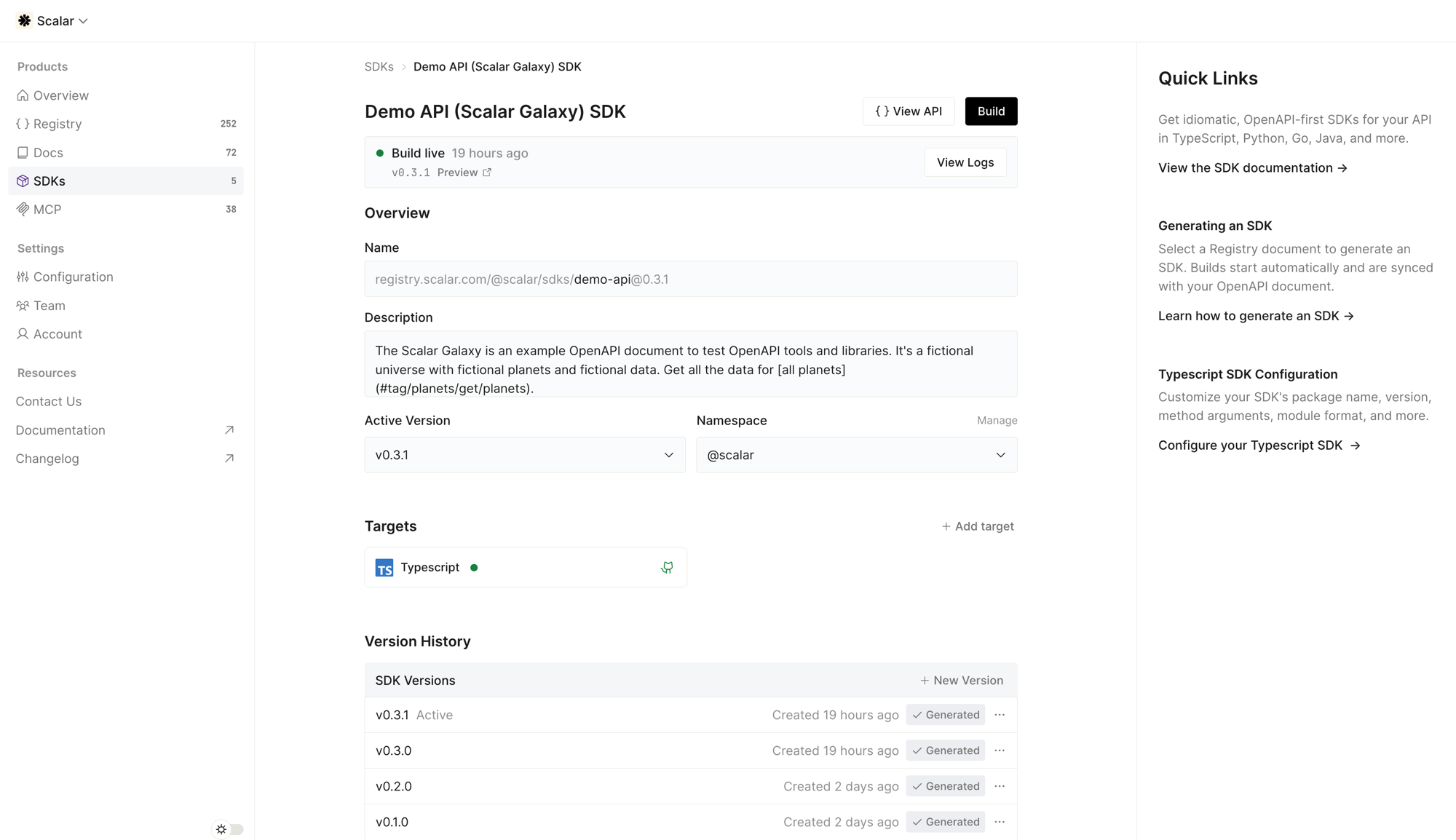
Read the code before committing to anything
Every target gets a preview repository, provisioned automatically. Browse the generated code, the api.md reference, and the README before you wire up a repository of your own.
Link your own repository
Connect the repository where the SDK should live. Scalar authors commits through a GitHub App installation, never a personal token. Every build pushes generated output to scalar-generated, merges it with your custom code on scalar-next, and keeps a release pull request open against the branch you nominate.
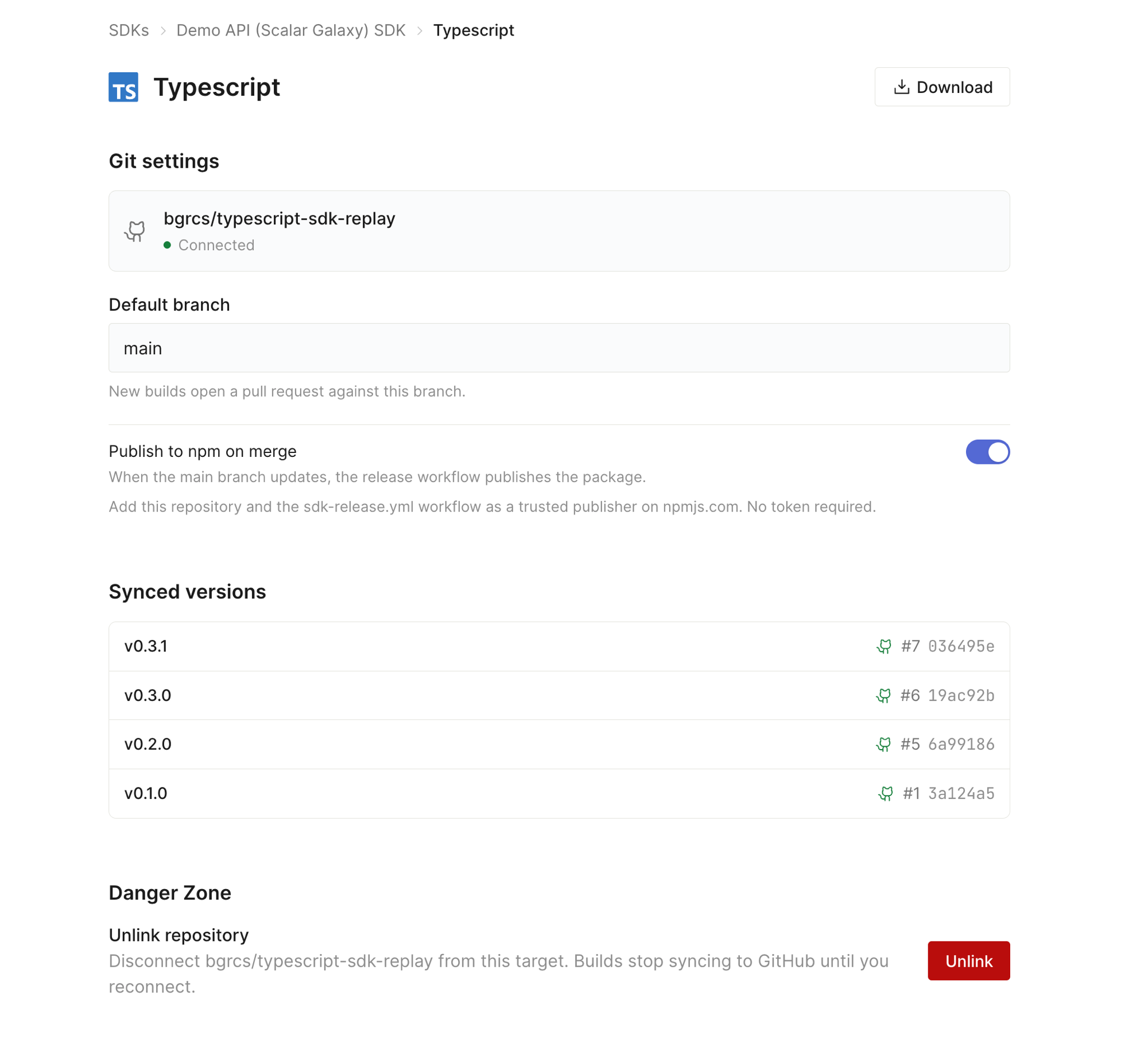
Publish from your repository
release-please versions the release pull request from your commit history and maintains the changelog. When you merge it, the workflows in your repository cut the tag and GitHub Release and publish the package. Your package names, registries, and release history stay yours. See publishing.
Let it follow your API
Point each SDK at an exact version of your API document or at a semver range such as ^1.2.0. When a matching document changes, Scalar mints a new SDK version and rebuilds, so one commit updates every target.
Your custom code survives regeneration
Generated SDKs rarely cover every need. You will want a convenience method, a tweaked type, a helper, or a better README, and no generator should make you choose between that and staying up to date.
Edit generated files as you would any other code. Every build performs a three-way merge between the previous generation, the new generation, and the current state of your repository, then opens a pull request combining the two. Untouched files update cleanly, your edits ride along, and files you added yourself are left alone.
For code you want held in place explicitly, mark a region:
// scalar-sdk-generator:custom-code retry-helper:start
export const withBackoff = async <T>(fn: () => Promise<T>) => {
  // Anything in here is carried forward on every regeneration.
};
// scalar-sdk-generator:custom-code retry-helper:end
Conflicts happen only when a regenerated file changes the same lines you edited. When that happens, the build surfaces the conflict as a pull request you resolve on GitHub like any other merge conflict. The whole flow runs on managed branches you can inspect yourself: scalar-generated holds pristine output, scalar-next holds output merged with your commits, and scalar-merge-conflict carries anything that needs a human. Read more in custom code.
Built for coding agents
Agents write a growing share of the code that calls your API, and they are the consumers most likely to invent a method name that does not exist. Every generated SDK ships the context needed to prevent that.
- An Agent Skill at
SKILL.md, plus.claude/skills/<name>/SKILL.mdfor automatic discovery, covering installation, client construction, authentication, and how to look up a call signature. - A generated
api.mdlisting every operation with its request and response types, designed to drop straight into an agent's context. - An
openapi.augmented.jsoncarrying your description alongside generated code samples and installation metadata.
All three are on by default, and all three are readable right now in the generated Warp SDK.
Tested against SDKs that ship
An SDK generator is only worth what its output survives, so most of the engineering here is testing rather than templating.
A harness compares our output to client libraries companies actually publish, on public API shape and on live wire traffic.
Generated harnesses call every operation against a mock server and report which ones fail.
The parity harness is the part we would want to see as a buyer. It clones production SDKs at pinned commits, extracts the public surface from both, and fails on drift in operation coverage, wire shapes, unions, enums, pagination behavior, requiredness, or parameter location. Then it drives both clients through every shared operation against a recording mock and diffs the requests they send.
Coming from Stainless?
Stainless is winding down its hosted SDK generator. Scalar reads your existing stainless.yml directly, so your resources, method names, pagination schemes, and per-language package names carry across and the call sites your users have already written keep working.
Read the Stainless migration guide for the practical steps, or Scalar vs Stainless for the product comparison. If you have not settled on a replacement yet, the wind-down write-up covers the whole field, including where other generators are the better answer.
Plans
Every plan includes one SDK target, and pricing scales with the size of your SDK — measured by the number of endpoints in your OpenAPI document. Additional targets are priced by each SDK's size: $150 per month each for up to 100 endpoints or $600 per month each for 101–250 endpoints. Business teams can use both price bands, and the included SDK applies to the most expensive band first. Enterprise SDK pricing is custom.
| Free | Pro | Business | Enterprise | |
|---|---|---|---|---|
| SDK targets included | 1 | 1 | 1 | Custom |
| Included SDK size | Up to 25 endpoints | 100 endpoints | 250 endpoints | Custom |
| Additional targets | - | $150 / month each | $150–$600 / month each, by SDK size; volume discounts | Custom pricing; volume discounts |
| Every target free during your trial | Included | Included | Included | Included |
| SSO/SAML | - | - | Included | Included |
| RBAC, priority support, and dedicated Slack or Teams support | - | - | - | Included |
A target becomes billable when you save a version and queue its build. Drafts are never billed. See the full comparison for SDKs and the other Scalar products.
Frequently asked questions
Which targets are production ready?
TypeScript, Python, Go, Java, Kotlin, Ruby, and the CLI target are generally available, and they are in production at Warp, Profound, Dedalus Labs and others. The rest are marked experimental in the dashboard. C# sits in the same continuous integration matrix as the generally available targets and is the closest behind them. PHP, Rust, Swift, Dart, and C++ generate working code, and we would rather talk to you first than have you discover a gap in production.
Do I own the generated code?
Yes. The SDK lives in your repository, under your package name, published to your registry accounts. Scalar opens pull requests against it and never cuts tags or releases on your behalf.
What happens to code I wrote by hand?
It is carried forward. Every build three-way merges the new generation with the current state of your repository, so your edits survive. Marked custom-code regions are preserved explicitly, and files you added yourself are never touched. Conflicts arrive as a pull request you resolve on GitHub.
Where can SDKs be published?
npm, PyPI, Go modules, Maven Central, RubyGems, NuGet, Packagist, crates.io, the Swift Package Manager, pub.dev, and Homebrew for CLI targets. Publishing runs from workflows generated into your repository, with actions pinned by commit SHA and trusted publishing where the registry supports it.
Which authentication schemes are supported?
API keys in a header, query parameter, or cookie; HTTP Basic; Bearer tokens; and OAuth 2.0 and OIDC schemes declared in your description. Each credential gets an environment variable default, and you can supply an async provider for tokens you fetch or refresh yourself.
Does my OpenAPI document need to be perfect?
No. Scalar generates a starting configuration from whatever you have, covering naming, pagination, and authentication. You then refine it in the configuration editor rather than by rewriting your description.
What keeps my SDKs in sync with the API?
Each SDK follows its API document by exact version or by a semver range you set. When a matching document changes, Scalar mints a new SDK version, rebuilds every target, and opens the pull requests. One commit to your API updates all of your clients.
See the generator in action
Every target comes out of the same OpenAPI document, gets reviewed in the dashboard, and ships from your own repository. Here is that flow end to end.


Ready to generate your first SDK?
Follow the Getting Started guide to generate a target from the dashboard, or bring an existing configuration and we will do the migration with you.
Related
- Learn: Generate an SDK from OpenAPI · Build vs buy an SDK
- Docs: Getting started with the SDK generator
- Product: Registry — keep the OpenAPI document your SDKs follow versioned in one place